

Consider this: You've finished a project at work and are ready to move on to the next task. You open your computer, and there's a wave of panic as you see dozens of files and applications on your screen, reminding you of the many notes I'd made along the way. What's worse, you can't find what you're looking for.
Sound familiar? This is just one of the many scenarios in which having a second brain can help. The concept of a second brain—a digital space for storing and organizing your notes and ideas—has gained popularity in recent years as more people embrace remote work and online learning.
This post'll explore how to build a second brain to help you with your work and studies. We'll discuss the Second Brain Code, a framework for creating a second brain, and how to use artificial intelligence to organize and control your notes.
Benefits of Building a Second Brain

Blast Through Your Projects and Goals
Completing projects and reaching goals can be tricky when your mind is bogged down in details. Organizing your knowledge outside your head frees you to execute more effectively in the moment. You can spin up and complete your projects far faster because you’re starting with a collection of valuable material and reusing work you’ve already performed instead of a blank page. Your creative confidence will be released as you accomplish your goals at a steady clip, allowing you to take on even bigger challenges.
Establish a Creative Process to Produce Your Best Work
Creativity is the currency of our modern economy, yet, for many people, it’s unpredictable and mysterious. A second brain is the home of your creative process, a series of habits and routines for consistently publishing your work without overthinking it or being too perfectionistic. Immersing ourselves in a pool of wealthy triggers, associations, questions, and ideas we’ve collected over time, we can more reliably spark our inspiration and creativity when we most need it.
Transform Knowledge Into Income and Opportunities
You can find an audience, gain a following, and create new income streams by publishing your knowledge in small bits online. Whether this becomes a business or a hobby, you’ll find countless new opportunities and career options. We live in the most incredible entrepreneurship age the world has ever seen. With all your best ideas, insights, and research, you can ride the wave of a rapidly expanding knowledge-based economy.
Enhance Your Thinking and Uncover Patterns and Connections
In a knowledge economy, your career trajectory depends a lot on the quality of your thinking. Instead of always trying to think of something brilliant on the spot, you can collect the best stories, images, observations, anecdotes, and metaphors in one central place, priming your imagination and revealing connections between ideas. A second brain helps you recognize larger patterns that allow you to see trends, uncover unexpected connections, and even spot opportunities before anyone else.
Reduce Stress and Information Overload
The amount of information we are now expected to consume and keep track of is staggering. By outsourcing the job of remembering to an external tool, we gain the peace of mind of knowing exactly what to do with each piece of incoming information and the confidence that it will never be forgotten. We can better manage our fears and anxieties by getting them out of our heads and planning to address them. By expertly curating and managing your personal information stream, you can make sense of the enormous volume of information you encounter daily and transform information overload into a clear mind.
Develop Valuable Expertise and Credibility for a New Job, Career, or Business
Your greatest asset is the knowledge you’ve gained through your experience. But until others can access that knowledge without taking your time, you’ll be chained to a desk. The great potential of making your knowledge tangible is that it frees you to spend your life as you want while still providing value to others. By cultivating a collection of knowledge that belongs to you and that you take from job to job, an economy of frequent job changes becomes an opportunity for learning instead of a threat.
Unlock the Wealth of Learning Resources Around You
We live through an explosion of online learning resources – online courses, webinars, books, articles, forums, podcasts, and other kinds of content- offering us priceless knowledge for free or at affordable prices. But without a way to break this knowledge into smaller pieces and store it until we need it, all this learning can feel like a waste of time and money. A second brain helps you take control of your learning by filtering and curating the most valuable bits you encounter and saving them in a searchable format. Reading and learning become more enjoyable and effective when we know that every potentially useful idea is being preserved.
Related Reading
- Second Brain Examples
- Tiago Forte Code
- Second Brain Notion Template
- Roam Research vs Obsidian
- Notion vs GoodNotes
How to Build a Second Brain in 12 Simple Steps

1. Utilize Constella for Enhanced Note-Taking
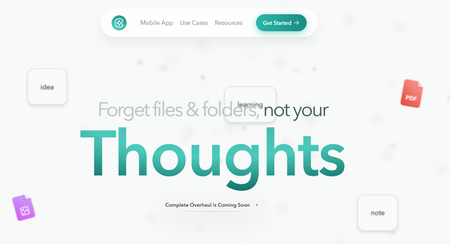
Constella transforms the approach to note-taking with its limitless canvas that enables you to capture and interlink ideas smoothly. The platform is powered by an AI search engine, allowing you to find information instantaneously. Constella is perfect for researchers aiming to discover connections between numerous papers or anyone who wants a more intuitive way to organize thoughts and files.
The AI assistant helps you build and navigate your knowledge base without the constraints of traditional folder structures. For busy knowledge workers and researchers, Constella transforms how you capture, find, and connect your ideas to research 10 times faster.
2. Identify What Information You Want to Capture
Your second brain serves as a personal commonplace book or journal. What do you want to capture, learn, explore, or share? Think about the types of content that will help you achieve your goals. Start by identifying two to three kinds of content you already value.
3. Select a Capture Tool
Start with a read-later app like Instapaper or Pocket to save any article or online content for later consumption. This one step will change how you think about consuming online content.
4. Organize Your Notes with PARA
Create the four folders of PARA (Projects, Areas, Resources, and Archives), and focus on actionability by creating a dedicated folder or tag for each of your currently active projects. From this point forward, capture notes related to those projects.
5. Get Inspired by Your Favorite Problems
Make a list of your favorite problems and save it as a note. Revisit this list anytime you need ideas for what to capture. Use these open-ended questions as a filter to decide which content is worth keeping.
6. Automate Capturing E-Book Highlights
Set up an integration to automatically send highlights from your reading apps (such as a read-later or e-book app) to your digital notes. Tools like Readwise or IFTTT make this easy.
7. Use Progressive Summarization
Summarize a group of notes related to a project you’re currently working on using multiple layers of highlighting to see how it affects how you interact with those notes.
8. Break Projects Down Into Intermediate Packets
Choose a project that might be vague, sprawling, or simply hard, and pick just one piece to work on—an Intermediate Packet. Maybe it is a business proposal, a chart, a run of show for an event, or key topics for a meeting with your boss. Break the project down into smaller pieces, make a first pass at one of the pieces, and share it with at least one person to get feedback.
9. Make Progress on One Deliverable
Choose a project deliverable you’re responsible for and use any workflow and express techniques outlined here. See if you can make decisive progress using only the notes in your Second Brain.
10. Schedule a Weekly Review
Put a weekly recurring meeting with yourself on your calendar to begin establishing the habit of conducting a Weekly Review. To start, just clear your notes inbox and decide on your priorities for the week. From there, you can add other steps as your confidence grows.
11. Assess Your Notetaking Proficiency
Evaluate your current note-taking practices and areas for potential improvement using our free Productivity Potential Quiz.
12. Join the PKM Community
Follow and subscribe to thought leaders on Twitter, LinkedIn, Substack, Medium, or your platform(s) of choice and join communities creating content related to personal knowledge management (#PKM), #SecondBrain, #BASB, or #toolsforthought.
Use Cases of Building a Second Brain

Unlocking the Potential of Memory with a Second Brain
With a Second Brain, you can systematically store notes, ideas, and references to reduce cognitive load. This makes it much easier to remember details and access them when needed.
Improve Your Organization with a Second Brain
Using a Second Brain, you can logically organize your study materials and resources to ensure systematic arrangement and quick retrieval. Tools like tags, folders, and databases help you easily create structure to find what you need.
Manage Projects More Efficiently with a Second Brain
A Second Brain enables you to efficiently track and manage tasks, deadlines, and progress, facilitating better project execution.
Enhance Your Creative Thinking with a Second Brain
By managing data efficiently, a Second Brain frees up mental space, allowing for more creative and strategic thinking.
Support Your Ongoing Personal Development with a Second Brain
A Second Brain allows you to store insights from books, articles, and personal reflections, supporting continuous learning and personal growth.
What is the Code for Building a Second Brain?

Capture: Collecting Only What’s Necessary to Build an Effective Second Brain
When you begin building a Second Brain, the first step is to "capture" the ideas and insights you think are worthwhile to save. There’s a lot of information out there. You can’t possibly keep it all. If you did, your Second Brain would be more like a junkyard. Instead, think like a curator and keep only what resonates with you.
Ask yourself:
- What are the recurring themes and questions I always return to in my work and life?
- What insightful, high-value, impactful information do I already have access to that could be valuable?
- Which knowledge do I want to interconnect, mix and match, and periodically resurface to stimulate future thinking on these subjects?
Most of the time, we tend to capture information haphazardly. We email ourselves a quick note, brainstorm some ideas in a Word document, or take notes on books we read, but then we don’t do anything with them.
We are already consuming or producing this information. We just need to keep it in a centralized place, such as a digital note-taking app like Constella. These apps facilitate capturing small snippets of text and hyperlinks, images, webpages, screenshots, PDFs, and other attachments, all of which are saved permanently and synced across all your devices.
Keeping a diverse collection of information in one centralized place allows it to intermingle, helping us see unexpected connections and patterns in our thinking. This also gives us one place to look when we need creative raw material, supporting research, or a shot of inspiration.
Organize: Getting the Information in Your Second Brain Ready for Action
As you begin to collect notes on ideas that resonate with you, you will eventually need to organize them. It can be tempting to create a perfect hierarchy of folders from the get-go, to capture every possible note I encounter. However, this approach is time-consuming and diverts your attention from what interests you now, requiring too much effort.
Most people organize information by subject, similar to the Dewey decimal system used in libraries. Books might be classified under broad subject categories such as Architecture, Business, History, or Geology.
Regarding digital notes, more straightforward and more flexible organization methods are preferable. Our priorities and goals can change quickly, so we should avoid organizing methods that are overly rigid and prescriptive.
The best way to organize your notes is to focus on your active projects. When you encounter new information, consider how it can help you move forward with your current work.
Surprisingly, focusing on taking action will also help you combat information overload. There are relatively few actionable and relevant things at any given time, making it easier to ignore everything else.
Organizing for action can provide a great sense of clarity because you know that everything you’re keeping has a purpose and aligns with your goals and priorities. Instead of hindering your productivity, organizing becomes a tool to enhance it.
Distill: Sifting Through the Noise to Find What’s Useful
Once you collect valuable knowledge in a centralized place, you'll naturally notice patterns and connections. An article I read on gardening will give me insight into online marketing. An offhand comment by a client will give me the idea of creating a webpage with client testimonials. A business card I saved from a conference will remind me to follow up and propose a collaboration.
You can facilitate this process by distilling your notes into actionable, bite-sized summaries. It would be nearly impossible to review my 10 pages of notes on a book I read last year amid a chaotic workday, for example. But if I had just the book's main points in a 3-point summary, I could quickly remind myself of what it contains and potentially apply it to something I’m working on.
Express: Creating Tangible Outputs from Your Second Brain
This capturing, organizing, and distilling has one ultimate purpose: creating tangible results in the real world. Whether we want to lose weight, get a promotion at work, start a side business, or contribute to a cause we believe in, the true purpose of learning is to turn our knowledge into practical action.
With a substantial reserve of supporting material in your Second Brain, you never need to sit on an empty page and try to “think of something smart.” All creativity stands on the shoulders of giants, and you already have the best ideas of those giants documented in your notes.
What should you create? It depends on your skills, interests, and personality. If you are analytical, you could draw on a group of articles I’ve read about Big Data to write a blog post summarizing where I think machine learning is headed next.
If you like to perform, you could borrow ideas from my notes on YouTube cooking videos I’ve enjoyed to make one of my own. If I am campaigning for investment in my local park, I could distill the minutes from past city council meetings into a speaking agenda for my public comments at the next one.
With a Second Brain at your disposal, you always have something to inspire, remind, support, or guide you as you engage in the projects and interests that are important to you. You can draw on the total of your life experience and learning, not just whatever you can think of now.
Related Reading
- Roam Research Alternatives
- Amplenote vs Notion
- NotePlan Alternative
- Amplenote vs Obsidian
- Heptabase vs Obsidian
- Notion vs Evernote
Research 10 Times Faster with Constella
Constella is a note-taking tool that addresses the complexities of research. It provides users an infinite digital canvas to capture and organize their ideas. The platform's artificial intelligence helps users instantly find and connect scattered information, enabling them to focus on their work instead of their notes.
How Does Constella Work?
Using Constella, you can create a "hub" for any project you're working on. From there, you can jot down notes, upload files, and visualize how different concepts and ideas relate. The platform's AI assistant helps you navigate your knowledge base to quickly find the information you need to speed up your research. Rather than relying on traditional folder structures, which can be limiting, Constella lets you organize your notes in a way that genuinely makes sense to you.
What Are the Benefits of Using Constella?
If you're a researcher, knowledge worker, or student, Constella can help you accelerate your learning and get work done faster. Using the platform, you can uncover hidden insights within your notes to help you produce better work or spark creativity for your next big idea.
Related Reading
Want more insights like this?
Subscribe to get short productivity tips and useful summaries of new tools every week.
Want more insights like this?
Subscribe to get short productivity tips and useful summaries of new tools every week.


